6.Henk van Mastrigt
8th New Guinea Biology Conference

At the 8th New Guinea Biology Conference (Port Moresby (PNG), 26-28 September, 2006) 38 presentations were held, three by key-note speakers and 35 results of surveys. Five presentations were concerning entomological items, of which four were results of the New Guinea Research Center in Madang. The kind of surveys will be good examples for students and teachers in Papua. 
Markus Manumbor – Studying insects communities in PNG rainforests: a parataxonomist approach.
Darren Bito – Geographic variability of moth communities on the alien tree Spathodea campanulata in New Guinea and Bismarck Archipelago.
Steven Sau – Host specialization of leaf miners in lowland rainforest.
Elvis Tamtiai – Geographic distribution of Lepidoptera in PNG rainforest.
Leontine Baje – Host specialization of sap sucking insects in a lowland rainforest.

Posted in Volume | Leave a comment

SUGAPA 1(1) [2006]
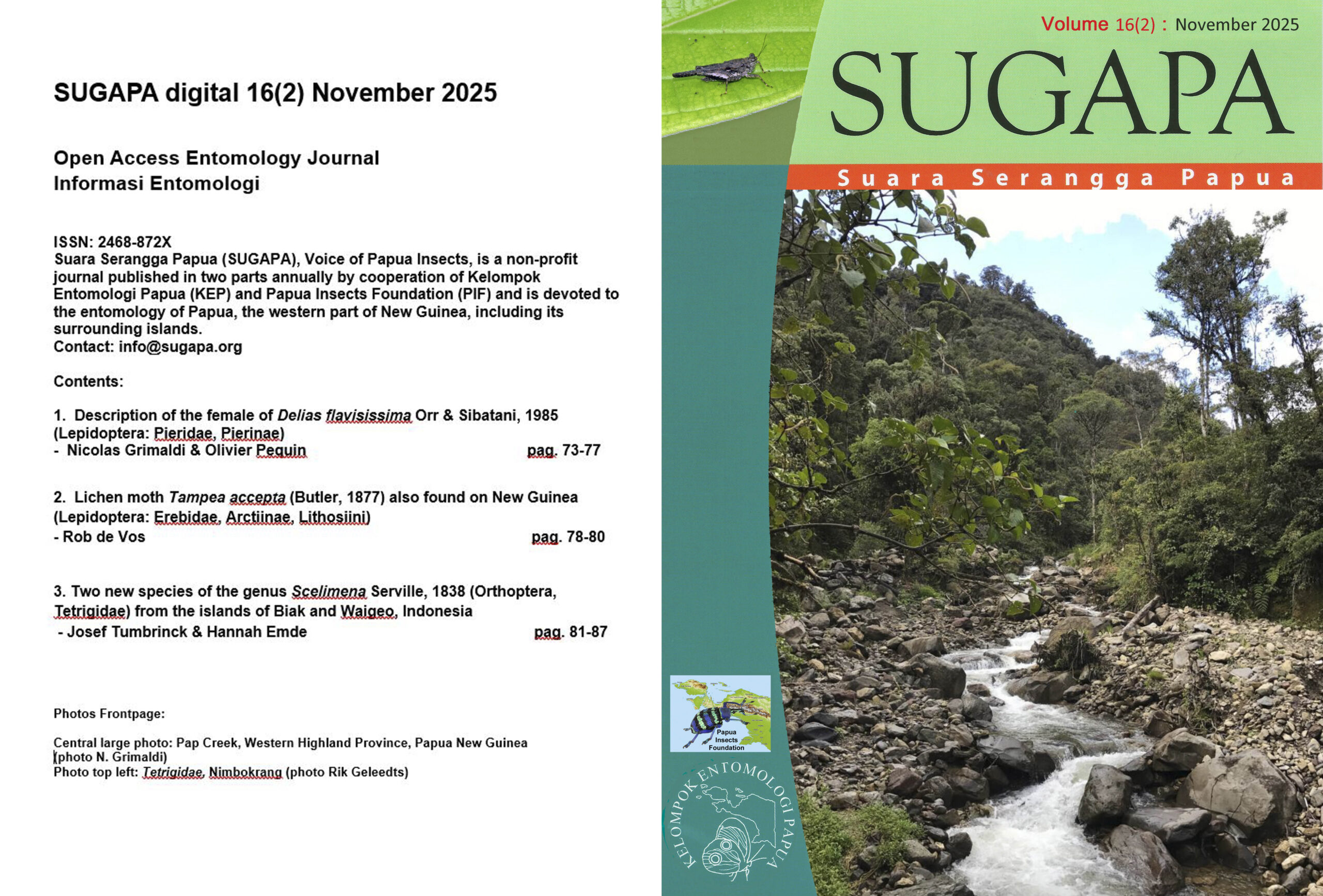
The cover of this Volume can be found on the page Covers

Suara Serangga Papua, 2006, 1 (1) July – October 2006


1.Henk van Mastrigt
Introduction of SUGAPA

Editorial
The editorial mentioned this edition as first number of a new magazine, edited and distributed by Kelompok Entomologi Papua (KEP), Entomological Workgroup in Papua and displays entomological information about Papua (formerly Irian Jaya Province), to enlarge the knowledge of the biodiversity of our nature, in order to be able to make conservation possible.

History
The first survey by Henk van Mastrigt with a student of the local University of Cenderawasih (UNCEN) was in 1996 to the Wandammen Mountains. Since 2001 Henk has been accompaning students in one or more surveys yearly. The collected specimens are in his private collection in Jayapura, now named Koleksi Serangga Papua (KSP, Papua Insect Collection), with over 42,000 specimens. Participants of the surveys became a member of a workgroup on entomology, which held its first meeting on November 9th 2005 and its second meeting on May 27th 2006, in which was decided to start a magazine, to have an own telephone number and e-mail address and to intensify its activities. So, the date of that second meeting was chosen as our birthday.

Vision and mission
KEP wants to survey the insect fauna of Papua, in order to know its biodiversity which will help to conserve Papua’s nature, in cooperation with various organizations and private persons (specialists in entomology) from inside and outside the country. Famous organizations as the World Wildlife Fund (WWF) and Conservation International (CI) have been working on this item from years and years, but their focus is more the larger animals as mamalia, birds and reptiles.
KEP also wants to provide information to above mentioned organizations, about endemism and results from ‘hot spots’, in order to preserve Papua’s forests. Information we forward to websites a.o. www.delias-butterflies.co.uk and www.papua-insects.nl and can be found in papers of students.
At the same time KEP wants to help teachers and students of the UNCEN and other universities in Papua, and support working at inventories and surveys on insects in Papua.
The results of these cooperations will help KEP to determine the ‘hot spots’ of biodiversity in Papua.

Plans for the next future
After the publication of “Buku Panduan Kupu-kupu” (see book corner) on butterflies from the Mamberamo area to the Cyclops Mountains, the idea was to publish more field guides from other areas in Papua. The Schouten Islands north of Papua (Numfor, Supiori, Biak, Japen and some other smaller islands) will be next, followed by the Birdshead Peninsula, including the Peninsula Raja Ampat, Tamrau and Arfak Mountains, Onin and Wandammen Peninsula. The priority of surveys is not only depending from the above mentioned targets, but also from the origin of the local students, invitations of organizations and sponsoring.

Content and purpose of magazine
In Suara Serangga Papua KEP want to publish – step by step – results of entomological surveys in the past and about other papers on entomology in Papua, and report the results of new surveys.
The editors will receive short articles from members of KEP and other interested people about themes which contribute to the entomological knowledge on Papua.
The magazine will be distributed to non-governmental organisations (NGO’s) in Papua interested in ecology and entomology, to governmental departments, universities and highschools, private subscribers and the members of KEP.

Download PDF:

Posted in Volume | Leave a comment

2.Henk van Mastrigt
Survey on the Pantai Timur Islands

Six students of the UNCEN visited the small islands in the district Pantai Timur (139º07’/139º30’ longitude, -1º58’/-2º07’ latitude) in the period July 15 – August 12, 2002. Three students visited Wakde, Masi-masi and Yamna, the others Podena, Yarson and Anus. The islands vary in size from 0.3 km2 (Podena) to 3 km2 (Wakde). 
A total of 59 species Lepidoptera were collected, of which 53 species on the three westernmost islands (Yamna being the richest with 40 species) and 37 species on the three eastern islands (Anus being the richest with 29 species).
The results of the survey of the western islands are reported by Alfrets Randang (2003), that of the eastern islands are reported by Henoch Wanggori (2004), who also made a comparisson between these results and those of the Mamberamo area, where once 129 species were collected: 26 species (44%) from the Pantai Timur Islands were not reported from the Mamberamo survey in the surrounding of Dabra.

Download PDF:

Posted in Volume | Leave a comment

3.Henk van Mastrigt
Survey on the Kumamba Islands

Six students of UNCEN visited the Kumamba Islands, north of Sarmi, from July 16th till August 12, 2002. The survey focussed on the population of Papilionoidea, mainly on the largest island Liki. The other two islands, Lambutu and Armo, were visited as well. 
A total of 60 species Lepidoptera were recorded: 52 on Liki, 4 on Lambutu and 22 on Armo. It comprises 4 Papilionidae, 5 Pieridae, 27 Lycaenidae and 24 Nymphalidae.
Remarkable was the absence of Graphium species and the high abundancy of Leptotes plinius at only a small area along the coast. Cyrestes acilia appeared to be very different from specimens on the mainland of New Guinea, and finally, Cepora perimale was only found on the smallest island, Lambutu, not on the other islands! Unfortunately the results are not yet reported.

Download PDF:

Posted in Volume | Leave a comment

4.Rinto H. Mambrasar
Survey on the island Numfor

In the months July and August in 2005 a survey was held on Numfor Island, with the purpose of collecting data of Papilionoidea and to make a comparisson between the distributions inside and outside the proposed nature reserve area (ca 1000 ha). The island Numfor is 391 km2 and has a maximum altidude of 200 meters. Its geographic position is between 134º47’ and 135º00’ longitude, and -0º57’ and -1º08’ latitude. There are about 9000 inhabitans.
The island was divided in six transects for observations, three of them outside the nature reserve (secundairy forest with gardens, a coastline and villages) and three inside the nature reserve (primary forest, secundairy forest with old gardens and secundairy forest with young gardens).
In 26 days 90 species of Lepidoptera were recorded: 9 Papilionidae, 12 Pieridae, 41 Lycaenidae and 28 Nymphalidae. Only one species was found exclusively outside the reserve. 
Threat of the biodiversity is caused by illegal deforestation by the local people, who also catch many birds. The establishment of many cocoa plantations and plans of a governmental restructurization, with the increase of cultivation, form serious threats to the flora and fauna of the island.

A complete report of the results of this survey is published in the essay of Rinto H. Mambrasar, to accomplishment of his study at the biological department of the FMIPA at the University of Cenderawasih in Jayapura.

Download PDF:

Posted in Volume | Leave a comment